Product
The sleeve that shrinks onto the bar: GSC, GMB, GHB
One cross-linked polyolefin sleeve in three recovered wall grades — 0.69 to 1.50 mm rated to 3.3 kV, 1.70 to 3.30 mm to 24 kV, 3.20 to 4.20 mm to 36 kV.
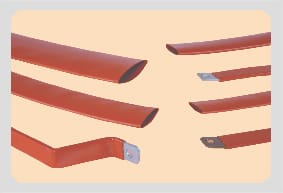
Heat-shrink busbar sleeve — GSC, GMB and GHB series
A heat-shrinkable, non-tracking cross-linked polyolefin sleeve that recovers onto rectangular or round bar and meets ANSI C37.20.2 for medium-voltage switchgear to 36 kV. The voltage class picks the series; the bar section picks the code inside it. Manufactured by Gala Thermo Shrink Pvt. Ltd.
- A 100 code is three different parts: GSC 100/50 takes a bar of 104–125 mm W+B, GMB 100/38 takes 83–126 mm, GHB 100/38 stops at 102 mm
- Recovers onto straight or angled bar without creasing
- Chemical protection stated against strong acid, alkali and salt
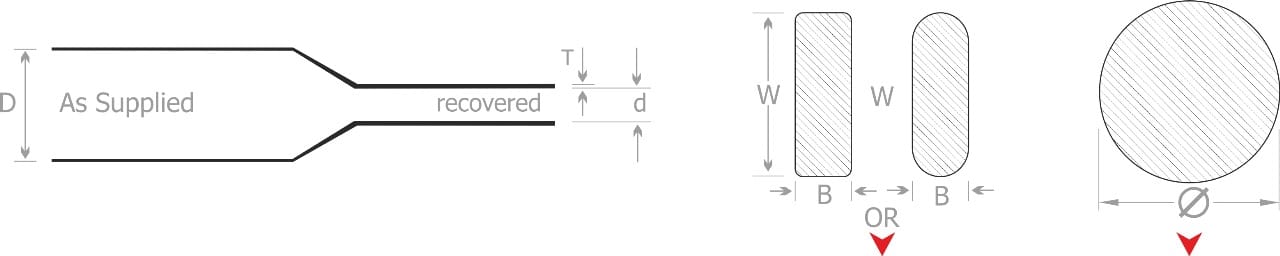
- Sizes to rectangular bar on width plus breadth, and to round bar on diameter
| Wall grades, recovered | GSC 0.69–1.50 mm · GMB 1.70–3.30 mm · GHB 3.20–4.20 mm, the wall column quoted ±10% |
|---|---|
| Voltage rating | GSC to 3.3 kV · GMB to 24 kV · GHB to 36 kV |
| Size codes | GSC 16/8 to 180/90 · GMB 16/6 to 250/100 · GHB 25/8 to 250/120 |
| Rectangular bar, width + breadth | GSC 16–236 mm · GMB 11–314 mm · GHB 20–314 mm |
| Round bar diameter | GSC 12–150 mm · GMB 7–200 mm · GHB 13–200 mm |
| Reel length | 100 m on GSC 16/8 and 20/10, 25 m across most of the range, 15 m on GHB 150/60 and 180/70, 1.5 m on the four 205 and 250 codes |
| Material | Non-tracking cross-linked polyolefin, halogen free, flame retardant |
| Switchgear standard | ANSI C37.20.2, medium-voltage application to 36 kV |
Voltage picks the wall; the bar picks the code
GSC is the thin-wall grade, 0.69 to 1.50 mm recovered, rated to 3.3 kV. GMB recovers to 1.70–3.30 mm and is rated to 24 kV. GHB recovers to 3.20–4.20 mm and is rated to 36 kV.
The range stops at 36 kV. Above GHB the specification moves to a separate GEHB series for 66 kV busbar, and no code on this page carries across to it — that range is set out on the 66 kV sleeve page.
Inside a grade the code follows the bar section, not the panel. Rectangular bar is matched on width plus breadth, so a 100 × 10 mm bar reads as 110 mm; round bar is matched on diameter.
The code number is not the bar size. At 110 mm the heavy-wall answer is GHB 120/45 and not GHB 100/38, whose published bar range stops at 102 mm. Every code, with its diameters, wall and reel length, is on the size chart.
Measured properties
| Property | Value | Test method |
|---|---|---|
| Dielectric strength | 22 kV/mm (min.) | ASTM D149 |
| Volume resistivity | 1 × 10¹³ Ohm·cm (min.) | ASTM D257 |
| Tracking, erosion and flame | No failure to 3.25 kV for 20 min | ASTM D2303 |
| Continuous temperature | −40 °C to +115 °C | IEC 216 |
| Shrink temperature | 125 °C | — |
Values as published by the manufacturer; the shrink temperature is published without a method of its own. What each of these standards actually measures is decoded once for the whole site, on the standards page.
What the wall buys back in phase spacing
| Voltage | Uninsulated, IEC 71-2 (mm) | GMB rectangular (mm) | GMB round (mm) | GHB rectangular (mm) | GHB round (mm) |
|---|---|---|---|---|---|
| 12 kV | 120 | 65 | 55 | 35 | 30 |
| 17.5 kV | 160 | 85 | 70 | 55 | 50 |
| 24 kV | 220 | 115 | 95 | 70 | 60 |
| 36 kV | 320 | 200 | 150 | 140 | 130 |
Phase-to-phase. The uninsulated column is published as a single figure per voltage, not split between phase-to-phase and phase-to-earth. The phase-to-earth set, and what 320 mm against 140 mm is worth in panel width, are on the clearance page. Note that the medium-wall row at 36 kV sits above GMB's own 24 kV ceiling, so it describes the manufacturer's table rather than a permitted selection.
Five limits the size chart does not show
- GSC stops at 3.3 kV. It is the thin-wall grade and it is the wrong part for an 11 kV panel however well it fits the bar.
- A sleeve covers a run, not a connection. Bolted laps, tees and elbows take a moulded shroud or a wrapped sheet — the geometries are set out under busbar connections.
- +115 °C is the sleeve's continuous limit, not the bar's.
- Chemical protection is stated against strong acid, alkali and salt. No other medium is named, so this is not a general chemical barrier.
- The reel-length column reads 1.5 m on the four largest codes — GMB 205/85, GMB 250/100, GHB 205/85 and GHB 250/120. Check the quantity against the run length before ordering those.
If the drawing says BUSTUBE
BUSTUBE is the manufacturer's trade name for this sleeve, and the name UL File E335936 lists alongside Busboot. The part codes are unchanged: a drawing calling for a heavy-wall busbar tube at 36 kV is calling for a GHB code. The range as published sits on the maker's own product page.
Reading a size code
A code such as GHB 100/38 carries two diameters. The chart heads them D mm (min.) and d mm (max.): D is the bore as supplied, d the bore after full recovery.
Neither number is a bar size. The chart publishes a separate bar range against every code — GHB 100/38 accepts a width plus breadth of 83 to 102 mm, or a round bar of 53 to 72 mm. That range is the figure to size on.
T is the recovered wall, and it is where the grades separate. GHB 100/38 recovers to 3.70 mm; GSC 100/50, the thin-wall code at the same supplied diameter, recovers to 1.40 mm. That 2.30 mm is the difference between a 3.3 kV part and a 36 kV one.
Next
- Busbar sleeve size chartEvery GSC, GMB and GHB code with D, d, T, reel length and bar range
- GEHB 66 kV busbar sleeveWhere the range goes above 36 kV
- Heat-shrinkable bus sheetThe wrapped alternative where a sleeve cannot be threaded on
- Installing a busbar sleeveMeasure, cut, shrink, inspect
- Cutting busbar air clearancePhase-to-earth figures and what the insulated numbers buy in enclosure width
- Five ways to insulate a busbarSleeve, shroud, cap, sheet and barrier board compared
Send a bar section and a voltage
Two numbers settle the code: the bar's width and breadth in millimetres, and the system voltage. Add the run length and the number of bends and the reel quantity comes out of the same message. Stated limit: this page sizes a sleeve to a bar section and rates it to a voltage class. It establishes nothing about the current that bar carries or the temperature it reaches in service — both are busbar design figures, and neither is settled by choosing an insulation.