Product
GEHB 66 kV busbar sleeve
Five codes, GEHB 50/20 to GEHB 150/60, every one of them 6.2 mm in the wall and 1500 mm long. Fitted, a 66 kV bar is quoted at 390 mm phase to phase against 630 mm bare.
GEHB is a separate series, not the top of the standard range
The standard BUSTUBE range stops at 36 kV: GSC thin wall to 3.3 kV, GMB medium wall to 24 kV, GHB heavy wall to 36 kV. GEHB is published as its own extra-heavy-wall chart with its own five codes, and no source runs one continuous rating from 3.3 kV through to 66 kV. "Heavy wall" is the published name of the 36 kV grade, not of this one, so a drawing that wants busbar sleeving at 66 kV has to name a GEHB code to get one.
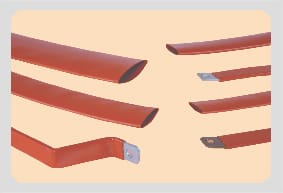
GEHB 66 kV Bus Tube
A heat-shrinkable, non-tracking cross-linked polyolefin sleeve that recovers onto 66 kV busbar and meets ANSI C37.20.2 for switchgear application at that voltage. Halogen free and flame retardant. Manufactured by Gala Thermo Shrink Pvt. Ltd.
- Recovers over straight or angled bars without creasing
- Guards a live bar against accidental flashover
- Insulates between bars inside a bus duct
- Chemical protection stated against strong acid, alkali and salt
| Size codes | GEHB 50/20, 75/28, 100/38, 120/45 and 150/60 |
|---|---|
| Bore, supplied and recovered | D 50–150 mm as a minimum, d 20–60 mm as a maximum |
| Wall, T | 6.2 mm ±10% on all five codes |
| Supplied length | 1500 mm on all five codes |
| Material | Non-tracking cross-linked polyolefin, halogen free, flame retardant |
| Continuous temperature | −40 °C to +105 °C |
| Clearance at 66 kV | 390 mm phase to phase, 520 mm phase to earth |
| Switchgear standard | ANSI C37.20.2, 66 kV application |
Where the 240 mm goes
A 66 kV bar carrying GEHB is quoted at 390 mm phase to phase. The same bar left bare is published at 630 mm. That 240 mm per gap is the whole commercial argument for the part.
Three bars in a flat run leave two gaps, so the arithmetic is 480 mm off the width the phases alone demand. Phase to earth drops to 520 mm, which is the figure governing how close the bar sits to the enclosure wall and to earthed steelwork crossing behind it.
Two of those three numbers are attributed and one is not. The 36 kV table names IEC 71-2 over its bare column; the 66 kV table carries 630 mm with no standard named over it. Confirm that figure against the clearance standard the design is signed off to before an enclosure width is fixed.
66 kV clearance, sleeved against bare
| Clearance | GEHB fitted | Bare bar, as published |
|---|---|---|
| Phase to phase | 390 mm | 630 mm |
| Phase to earth | 520 mm | Not separately published |
One bare figure, 630 mm, is published beside both sleeved figures. Unlike the 36 kV table it carries no standard reference and no split between rectangular and round bar, so read it as the phase-to-phase comparison and check the phase-to-earth case separately. The 12, 17.5, 24 and 36 kV rows sit on the clearance page.
The five GEHB codes
| Code | D, supplied bore (mm, min.) | d, recovered bore (mm, max.) | Wall T (mm, ±10%) | Length (mm) |
|---|---|---|---|---|
| GEHB 50/20 | 50 | 20 | 6.2 | 1500 |
| GEHB 75/28 | 75 | 28 | 6.2 | 1500 |
| GEHB 100/38 | 100 | 38 | 6.2 | 1500 |
| GEHB 120/45 | 120 | 45 | 6.2 | 1500 |
| GEHB 150/60 | 150 | 60 | 6.2 | 1500 |
D and d are internal diameters. This series publishes no bar range — no width-plus-breadth figure for rectangular bar and no diameter range for round — where the GSC, GMB and GHB chart publishes both, so the bar section has to be taken against the recovered bore and confirmed with the manufacturer. The 36 kV codes are on the size chart.
What does not carry across from GHB
All five GEHB codes reuse a GHB number. GHB 50/20, 75/28, 100/38, 120/45 and 150/60 sit on the 36 kV chart at the same two bores. The wall is where they part: 3.50 to 3.70 mm on those GHB codes against 6.2 mm here.
The property tables part as well. The 36 kV grades are published at −40 °C to +115 °C continuous and 1 × 10¹³ Ohm·cm; GEHB is published at +105 °C and 1 × 10¹⁴. The higher-voltage part carries the lower temperature ceiling, which is the reverse of what borrowing a figure across would assume.
Supply differs too. The 36 kV chart quotes reel length in metres, 15 to 25 m on most codes, and the GEHB chart quotes 1500 mm. Both tables as published sit on the manufacturer's 66 kV Bus Tube page.
Measured properties
| Property | Value | Test method |
|---|---|---|
| Dielectric strength | 22 kV/mm (min.) | ASTM D149 |
| Volume resistivity | 1 × 10¹⁴ Ohm·cm (min.) | ASTM D257 |
| Dielectric constant | 5 (max.) | ASTM D150 |
| Tracking, erosion and flame | No failure to 3.25 kV for 20 min | ASTM D2303 |
| Continuous temperature range | −40 °C to +105 °C | IEC 216 |
| Shrink temperature | 125 °C | IEC 216 |
| Low-temperature flexibility | No cracking after −40 °C for 4 h | ASTM D2671 |
| Heat shock | No cracking or flowing after 250 °C for 30 min | ESI 09-11 |
| Accelerated ageing | 120 °C for 500 h, retaining 10 N/mm² and 250% | ASTM D2671, retested to ASTM D638 |
| Tensile strength | 12 N/mm² (min.) | ASTM D638 |
| Ultimate elongation | 350% (min.) | ASTM D638 |
| Hardness | 45 ± 10 Shore D | ASTM D2240 |
| Density | 1.20 ± 0.2 g/cm³ | ASTM D792 |
| Water absorption | 0.5% (max.) | ASTM D570 |
Values and methods as published by the manufacturer for this series, not carried over from the 36 kV grades. What each standard actually measures is decoded once for the whole site, on the standards page.
What a 66 kV job does differently
Six things separate this part from the 36 kV sleeve on the bench, and every one of them comes off the numbers above.
- Heat input. Shrink temperature is 125 °C, the same as on the 36 kV grades, but into 6.2 mm of wall instead of 3.50 to 3.70 mm. Recovery time per metre learned on GHB does not transfer. Prove it on an offcut of the same code.
- Temperature ceiling. +105 °C is the sleeve's continuous limit and it is 10 °C below the 36 kV grades'. A bar checked against GHB's +115 °C has been checked against the wrong number.
- Sizing. With no published bar range, the bar section is matched against d, the recovered bore — 20 mm on the 50/20 code up to 60 mm on the 150/60 — and confirmed with the manufacturer before the code goes on a bill of materials.
- Length. 1500 mm a piece on every code, against 15 to 25 m reels on most of the 36 kV range. Any run over 1500 mm puts a joint in the covering.
- Where the saving is spent. 240 mm a gap only shrinks a panel if phase spacing set the enclosure width. Where a breaker footprint or a gland plate set it, the sleeve buys flashover margin and nothing dimensional.
- Straight run only. The sleeve covers bar between fittings. Bolted tees, elbows and open ends take a shroud, a bus sheet or a cap, each a separate part with its own code.
Next
- Busbar sleeve size chartEvery GSC, GMB and GHB code with D, d, T, reel length and bar range. GEHB is not on it.
- The 36 kV heat-shrink sleeveGSC, GMB and GHB — where most panel work actually lands.
- Cutting busbar air clearanceWhat 390 mm against 630 mm is worth in enclosure width.
- Installing a busbar sleeveMeasure, cut, shrink, inspect.
- Busbar connection geometriesWhat covers a tee, an elbow and an open end.
Send the bar section and the voltage
A 66 kV enquiry is answered in one reply when it carries the bar's width and breadth, the run length, whether ends and joints also need covering, and the destination. Stated limit: this page establishes the clearance GEHB is quoted at, the five codes it is made in and the properties published against it. It establishes nothing about the current the sleeved bar carries, the temperature it reaches in service, or the derating that follows from covering a conductor — those are busbar design figures, and no source behind this page settles them.