Product · non-shrinkable
GBBS barrier board sheet
The one part in this range that no heat goes near. It is cut and drilled with workshop tooling and fixed in place — 670 or 970 mm wide, 15 m long, 2.0, 3.0 or 5.0 mm thick.
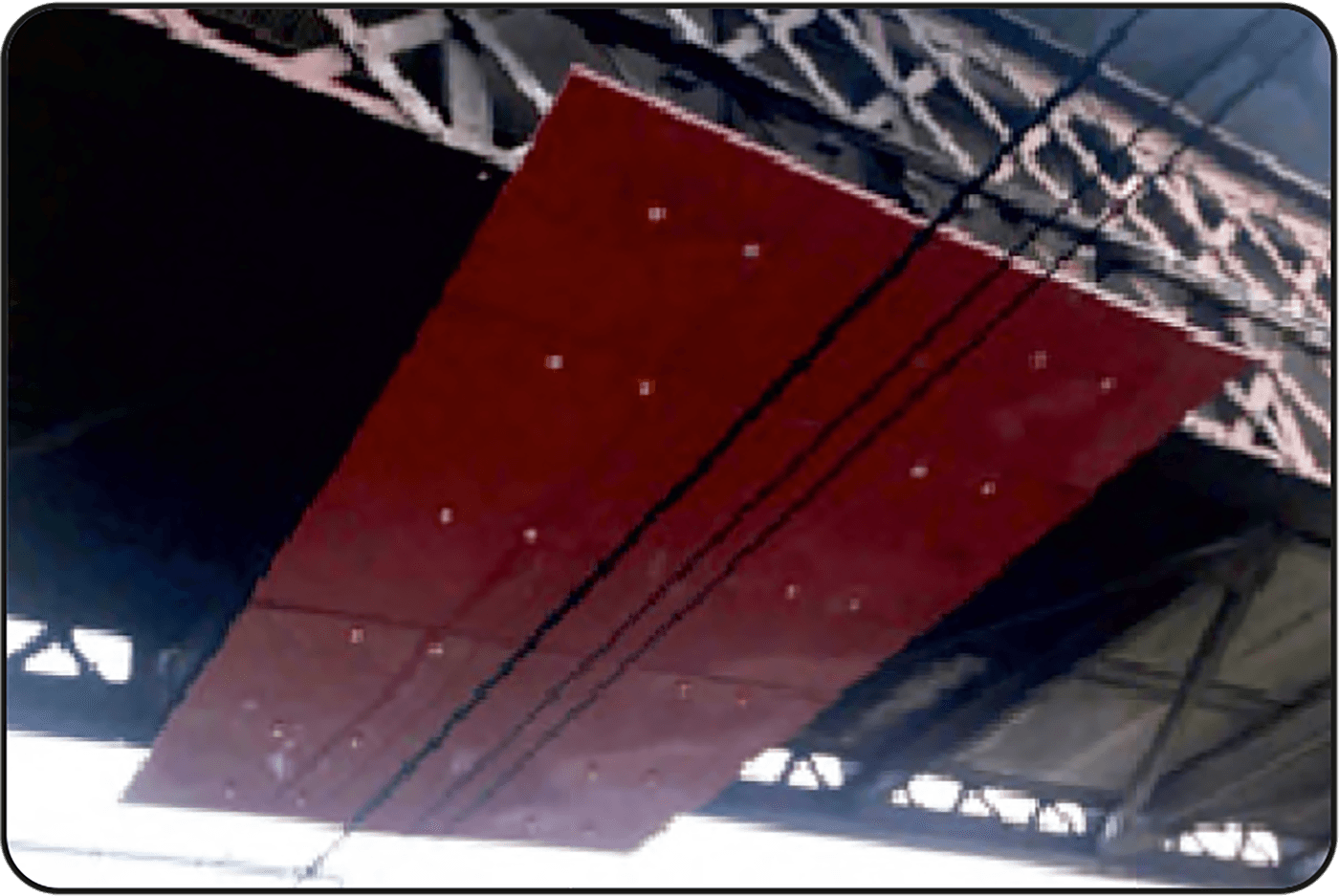
Barrier board sheet, GBBS series
A non-shrinkable polyolefin sheet in three thicknesses and two widths, supplied 15 m long and cut to the opening it has to fill. Gala Thermo Shrink Pvt. Ltd. make it at Palghar, Maharashtra and Surat SEZ, Gujarat; we size and specify, we do not manufacture.
| Product codes | GBBS-2, GBBS-3, GBBS-3A, GBBS-5A |
|---|---|
| Thickness | 2.0, 3.0 or 5.0 mm |
| Width | 670 mm or 970 mm |
| Length | 15 m |
| Material | Polyolefin, non-shrinkable, halogen free |
| Dielectric strength | 20 kV/mm minimum |
| Hardness | 40 ±5 Shore D |
| Continuous temperature limit | −45 to +105 °C |
| Installation | Cut and drilled, no special equipment |
Technical specification
| Property | Value | Test method |
|---|---|---|
| Tensile strength | 10 N/mm² (MPa) min. | ASTM D638 |
| Ultimate elongation | 350 % min. | ASTM D638 |
| Density | 1.20 ± 0.2 g/cm³ | ASTM D792 |
| Hardness | 40 ±5 Shore D | ASTM D2240 |
| Water absorption | 0.5 % max. | ASTM D570 |
| Accelerated ageing | 90 °C for 7 days | ASTM D2671 |
| — tensile strength after ageing | ± 25 % variation | ASTM D638 |
| — ultimate elongation after ageing | ± 25 % variation | ASTM D638 |
| Low-temperature flexibility, −40 °C for 4 hrs | No cracking | ASTM D2671 |
| Continuous temperature limit | −45 to +105 °C | IEC 216 |
| Dielectric strength | 20 kV/mm min. | ASTM D149 |
| Volume resistivity | 1 × 10¹⁴ Ohm·cm min. | ASTM D257 |
| Dielectric constant | 5 max. | ASTM D150 |
| Resistance to tracking and erosion | No tracking, erosion or flame failure to 3.25 kV, 20 min | ASTM D2303 |
Methods in the third column are decoded once, on busbar insulation standards. Values as published by the manufacturer.
Selection chart
| Product code | Width | Length | Thickness |
|---|---|---|---|
| GBBS-2 | 670 mm | 15 m | 2.0 mm |
| GBBS-2 | 670 mm | 15 m | 3.0 mm |
| GBBS-3 | 670 mm | 15 m | 5.0 mm |
| GBBS-3A | 970 mm | 15 m | 3.0 mm |
| GBBS-5A | 970 mm | 15 m | 5.0 mm |
Two rows share the code GBBS-2, at 2.0 mm and at 3.0 mm, and the numeral in a code does not track its thickness — GBBS-3 is 5.0 mm, GBBS-3A is 3.0 mm. Put the width and the thickness on the order line as well as the code.
Published behaviour
The manufacturer's own feature list for GBBS. The arc line is the one that appears against no other product page in the busbar range.
- Withstands a power arc without changing shape, and wipes clean afterwards with no visible surface damage.
- Resists mechanical impact and wear.
- Holds 3.25 kV for 20 minutes with no tracking, no erosion and no flame failure.
- Halogen free, and resistant to chemicals, solvents, alkali and salt.
- UV-stabilised and weather resistant, indoors or outdoors.
- Machines by cut and drill without special equipment.
Two jobs, one of them outside the cabinet
The first job is inside a switchgear cabinet: an inter-phase barrier against flashover. The manufacturer names the three initiators it is fitted against — contaminants, moisture and animals. Contamination as a flashover route is set out for the whole range on how busbar insulation fails.
The second job is outside the cabinet. GBBS secures and insulates the underside of a structure whose clearance to a live part has been reduced. The manufacturer's photograph of that job shows a board bolted flat under a steel roof truss, fastener heads in a grid across its face, conductors running below it.
Against the shrinkable parts, the difference is heat. A bus sheet is wrapped over the joint and brought down with a gas torch or a hot air gun; a sleeve recovers onto the bar at temperature. GBBS is non-shrinkable and machines by cut and drill, so nothing on this part is heated.
Two widths are published, 670 and 970 mm, both 15 m long, and one dielectric figure covers the whole range: 20 kV/mm minimum, quoted per millimetre. No total withstand is published for 2.0, 3.0 or 5.0 mm. Nothing in the data says why a job would take one thickness over another, so that call sits with the panel builder and not with the chart.
The fixing detail is not published
No fixing method, hole pattern, bracket or edge treatment appears in the published data for GBBS. The selection chart gives sheet stock — two widths, 15 m long — and stops there. How the board is drilled, clamped or carried in the frame is the panel builder's design, and it belongs on the drawing before the sheet is ordered.
Sources and next pages
- Manufacturer's Barrier Board Sheet pageGala Thermo Shrink Pvt. Ltd. — source of the property table and the selection chart above
- Heat-shrinkable bus sheet, GMHS and GHHSThe shrinkable alternative: it wraps a tee or an elbow instead of standing beside it
- Five ways to insulate a busbarThe whole range, and which of the five touches the conductor
- Busbar insulation standardsASTM D149, D2303, D2671 and IEC 216 decoded once for the site
- Busbar in a switchgear panelWhere a barrier sits relative to the risers, the droppers and the cable box
Specifying a barrier board
Give the clear opening, the width, the thickness and the code — the thickness as well as the code, because GBBS-2 covers both 2.0 mm and 3.0 mm. One limit, stated plainly: a barrier interrupts a flashover path between phases. It does not insulate the bar standing beside it, and every code in the chart is a sheet width rather than a bar size. Where the conductor itself has to be covered that is a sleeve or a shroud, and the reason to cover it is the arithmetic on busbar air clearance.